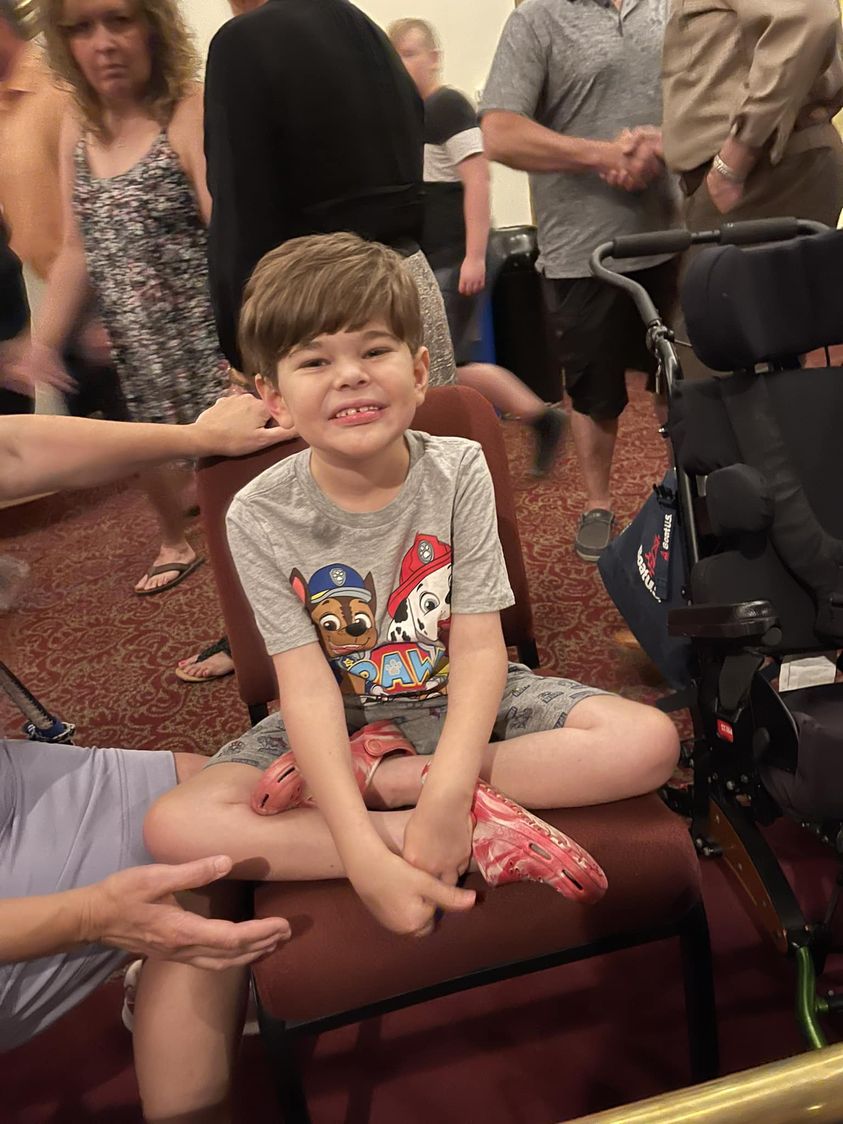
From the very beginning, Brayden faced medical challenges. He experienced multiple ear infections from birth, requiring tubes before his first birthday. Walking began at 17 months but was marked by frequent falls and a persistent clumsiness that caught the attention of his parents and doctors alike.
By ages 2 and 3, tremors emerged and his condition worsened significantly. A hospitalization for sudden inability to walk prompted extensive testing — including muscle biopsy and genetic testing with a neurological specialist in Rochester, New York — ultimately confirming SMA-PME. It was a devastating answer to years of worry, but it was also, finally, an answer.
Between ages 3 and 4, skin nodules appeared — a hallmark symptom of Farber disease — requiring skin biopsy and overseas consultation with specialists in France and Canada. By ages 4 and 5, throat nodules developed and Brayden received his first wheelchair. Seizures began at ages 5 and 6. By ages 6 and 7, respiratory infections escalated into aspiration pneumonia, leading to a feeding tube.
By ages 7 and 8, seizures had become a matter of daily life, and Brayden became completely wheelchair-dependent. Yet through every stage of his illness, his spirit has remained extraordinary. He loves baseball with a deep, undiminished passion — and those who know him describe him simply as "a very special and courageous boy."
Brayden's story is one of the clearest illustrations of why SMA-PME and Farber disease research are so deeply intertwined. Progress for one community is progress for both. He is the reason the work continues — and the reason it cannot stop.